
Noninvasive Stress Test
Contraindications for
-
Ongoing or recent STEMI or NSTEMI acute coronary syndrome or unstable angina, within the last 2 days or with ongoing/active symptoms of ischemia or heart failure
-
Elevated cardiac troponin of possible ischemic etiology, acutely rising or with ongoing/active symptoms of ischemia or ischemic ECG changes
-
Acute decompensated heart failure
-
Hypertension: Systolic BP at rest ≥ 200 mmHg or diastolic BP at rest ≥ 110 mmHg
-
Hypotension: Symptomatic hypotension or asymptomatic hypotension with systolic BP at rest ≤ 85 mmHg
-
Uncontrolled or unstable cardiac arrhythmia (atrial fibrillation, atrial flutter, SVT, VT)
-
Symptomatic severe aortic stenosis
-
Acute pulmonary embolism
-
Acute aortic syndrome, including acute Type A aortic dissection or acute Type B aortic dissection with symptoms
-
Third-degree AV block without a functioning pacemaker
-
Acute symptomatic significant medical illness
-
Inability to participate or cooperate with testing, or inability to remain still for imaging
Additional Contraindications for regadenoson stress
-
Patients with significant reactive/bronchospastic lung disease with ongoing wheezing or recent exacerbation requiring steroids/significant escalation of medical therapy
-
Second-degree Mobitz type 2 AV block without a functioning pacemaker
-
Severe Symptomatic bradycardia without a functioning pacemaker
-
Recent (<48 hours) use of dipiridamole or dipyridamole-containing medications
-
Symptomatic aortic aneurysm
-
Ingesting of caffeinated foods or beverages (eg, coffee, tea, sodas) within the last 12 hours
-
Seizure disorder with acitve seizure within the last 6 months
-
Known hypersensitivity to regadenoson
Additional Contraindications for dipyridamole stress
-
Patients with significant reactive/bronchospastic lung disease with ongoing wheezing or recent exacerbation requiring steroids/significant escalation of medical therapy
-
Second-degree Mobitz type 2 AV block without a functioning pacemaker
-
Severe Symptomatic bradycardia without a functioning pacemaker
-
Symptomatic aortic aneurysm
-
Ingesting of caffeinated foods or beverages (eg, coffee, tea, sodas) within the last 12 hours
-
Known hypersensitivity to dipyridamole
Additional Contraindications for adenosine stress
-
Patients with significant reactive/bronchospastic lung disease with ongoing wheezing or recent exacerbation requiring steroids/significant escalation of medical therapy
-
Second-degree Mobitz type 2 AV block without a functioning pacemaker
-
Severe Symptomatic bradycardia without a functioning pacemaker
-
Recent (<48 hours) use of dipiridamole or dipyridamole-containing medications
-
Symptomatic aortic aneurysm
-
Ingesting of caffeinated foods or beverages (eg, coffee, tea, sodas) within the last 12 hours
-
Seizure disorder with acitve seizure within the last 6 monts
-
Known hypersensitivity to adenosine
Additional Contraindications for dobutamine stress
-
Acute left ventricular thrombus, especially mobile, protruding, or pendunculated
-
Hypertrophic obstructive cardiomyopathy or other forms of significant left ventricular outflow tract obstruction
-
Prior history of VT
-
Symptomatic or severely enlarged aortic aneurysm
-
Poorly rate-contrilled atrial fibrillation/flutter
-
Known hypersensitivity to dobutamine
Cautions
-
Unrepaired large aortic aneurysm
-
Severe pulmonary hypertension
-
Known significant left main coronary artery stenosis or known high-risk coronary anatomy
-
Asymptomatic severe aortic stenosis
-
Uncorrected significant electrolyte abnormalities
-
active endocarditis
-
Recent stroke or transient ischemic attack or severe carotid stenosis
-
Significant anemia or ongoing bloodl oss
Additional cautions for exercise stress
-
Acute myocarditis or pericarditis
-
Poorly rate-controlled atrial fibrillation/flutter
-
Significant tachyarrhythmias or bradyarrhythmias
-
High-degree AV block (second-degree Mobitz type 2) without a functioning pacemaker
-
Significant left ventricular outflow tract obstruction (ie, hypertrophic obstructive cardiomyopathy or left ventricular outflow tract membrane)
-
Patient with LBBB or ventricular pacing should preferentially undergo pharmacologic vasodilator stress with stress testing is performed for assessment of myocardial ischemia
Additional cautions for regadenoson stress
-
Profound sinus bradycardia (heart rates ≤40/min)
-
Junctional rhythm
-
Acute left ventricular thrombus, especially mobile, protruding, or pedunculated
-
Ingestion of caffeinated foods or beverages (eg, coffee, tea sodas) within the last 24 hours
Additional cautions for dipyridamole stress
-
Profound sinus bradycardia (heart rates ≤40/min)
-
Junctional rhythm
-
Acute left ventricular thrombus, especially mobile, protruding, or pedunculated
-
Ingestion of caffeinated foods or beverages (eg, coffee, tea sodas) within the last 24 hours
-
Seizure disorder with active seizures withing the last 6 months
Additional cautions for adenosine stress
-
Profound sinus bradycardia (heart rates ≤40/min)
-
Junctional rhythm
-
Acute left ventricular thrombus, especially mobile, protruding, or pedunculated
-
Ingestion of caffeinated foods or beverages (eg, coffee, tea sodas) within the last 24 hours
-
Frequent premature ventricular contractions or NSVT
-
Patients with LBBB or ventricular pacing should preferentially undergo pharmacologic vasodilator stress when stress testing is performed for assessment of myocardial ischemia
Additional cautions for dobutamine stress
-
Frequent premature ventricular contractions or NSVT
-
Patients with LBBB or ventricular pacing should preferentially undergo pharmacologic vasodilator stress when stress testing is performed for assessment of myocardial ischemia
-
Patients who are on more than minimal or low doses of beta blockers, where the heart rate and inotropic responses to dobutamine will be attenuated
Indications for early termination/reversal for all stressors
Absolute indication for early termination/reversal for all stressors
-
Moderate to severe angina pectoris
-
Excessive ST-segment depression (horizontal or downsloping) > 2 mm from baseline in a patient with suspected ischemia/ischemic symptoms
-
ST elevation (>1.0 mm) in leads without diagnostic Q-waves (except for leads V1 or aVR)
-
Sustained SVT or VT
-
Development of symptomatic second- or third-degree AV block without functioning pacemaker
-
Development of LBBB or intraventricular conduction delay that cannot be distinguished from VT
-
Signs of poor perfusion (cyanosis and pallor)
-
Hypertensive response (systolic BP > 230 mmHg and/or diastolic pressure > 115 mmHg)
-
Severe hypotension (Systolic BP < 80 mmHg)
-
Inability to monitor the electrocardiogram or BP
-
Patient's request to stop
Additional absolute indications for early termination of exercise stress
-
Marked dyspnea
-
Ataxia, dizziness, or near-syncope
-
Drop in systolic BP of > 10 mmHg from baseline, despite an increase in workload, when accompanied by other evidence of ischemia
-
In patients with implantable cardioverter defibrillators, when the heart rate attained is within 20 bpm of the lowest heart rate at which therapy (anti-tachycardia pacing or shock) is programmed to be delivered
-
In patients with previously asymptomatic severe aortic stenosis, development of symptoms, drop in systolic BP of > 10 mmHg from baseline, ST-segment depression of > 2 mm, frequent or increasing frequency of ventricular ectopy/NSVT, significant hypertension, or target heart rate is achieved (80-85% of the age-predicted maximum).
Additional absolute indications for early termination/reversal of regadenoson stress
-
Symptomatic hypotension (systolic BP < 90 mmHg)
Additional absolute indications for early termination/reversal of dipyridamole stress
-
Symptomatic hypotension (systolic BP < 90 mmHg)
-
Wheezing
Additional absolute indications for early termination/reversal of adenosine stress
-
Symptomatic hypotension (systolic BP < 90 mmHg)
-
Wheezing
Additional absolute indications for early termination/reversal of dobutamine stress
-
Symptomatic hypotension (systolic BP < 90 mmHg)
-
In patients with implantable cardioverter defibrillators, when the heart rate attained is within 20 bpm of the lowest heart rate at which therapy (anti-tachycardia pacing or shock) is programmed to be delvered
Relative indications for early termination/reversal for all stressors
Absolute indication for early termination/reversal for all stressors
-
Development of persistent asymptomatic second-degree or complete AV block
-
Other significant cardiac arrhythmia
-
Excessive ST-segment depression (horizontal or downsloping) >2 mm from baseline in a patient without suspected ischemia/ischemic symptoms
-
Severe or increasing chest pain of unclear etiology
Additional absolute indications for early termination of exercise stress
-
Drop in systolic BP > 10 mmHg despite increasing workload in the absence of evidence of myocardial ischemia
Additional absolute indications for early termination/reversal of regadenoson stress
-
Can be considered in the presence of less severe side effects or ischemic ECG changes if at least 1 minute has elapsed since radiotracer injection
Additional absolute indications for early termination/reversal of dipyridamole stress
-
Can be considered in the presence of less-severe side effects or ischemic ECG changes if at least 1 minute has elapsed since radiotracer injection
Additional absolute indications for early termination/reversal of adenosine stress
-
Can be considered in the presence of less-severe side effects or ischemic ECG changes if at least 1 minute has elapsed since radiotracer injection
Additional absolute indications for early termination/reversal of dobutamine stress
-
A decrease in systolic BP from baseline in consecutive BP readings, especially when accompanied by ischemic ECG changes and/or anginal symptoms, should prompt evaluation of the etiology of the clinical changes (ischemia, vagal reflex, left ventricular outflow tract obstruction, among others) and consideration to hold the current infusion rate or discontinue the infusion altogather
Standard and modified Bruce protocols
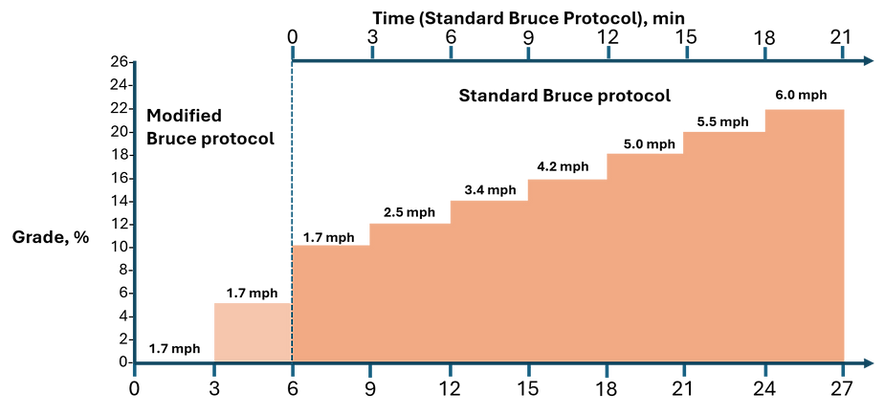
Proctocol
Modified Bruce
Standard Bruce
Stage
0
0.5
1
2
3
4
5
6
7
Minutes
3
6
9
12
15
18
21
24
27
Speed (mph)
1.7
1.7
1.7
2.5
3.4
4.2
5.0
5.5
6.0
Grade (%)
0
5
10
12
14
16
18
20
22
METs
2
3
4
7
10
13
15
18
20
References
1) Lane Duvall W, Skali H, Aggarwal NR, Boczar KE, Calnon DA, Chareonthaitawee P, Doukky R, Einstein AJ, Hage FG, Hutt E, Malhotra S, McMahon SR, Phillips LM, Taqueti VR, Trivedi SJ, Verberne HJ, Henzlova MJ. 2026 ASNC guideline for stress testing in single-photon emission computed tomography (SPECT) and positron emission tomography (PET) myocardial perfusion imaging. J Nucl Cardiol. 2026 Sep 8:102970. doi: 10.1016/j.nuclcard.2026.102970. Epub ahead of print. PMID: 42710612.
.